Imperial House of Yamato
Posted on
 Ninigi was A Japanese deity, grandson of the sun goddess Amaterasu. It is believed that Ninigi descended to earth and established the divine origin of the Yamato clan, the Imperial house of Japan. He is said to have been the great-grandfather of the first emperor, Jimmu. Amaterasu delegated Ninigi to assume ownership and rule of the central land of the reed plains (Japan) and gave him three signs of his charge: a jewel (symbolizing benevolence), a mirror (purity), and Kusanagi, the “grass-mowing” sword (courage). The jewel, the mirror, and the sword are still the Japanese Imperial symbols. On his descent to earth Ninigi landed on Kyushu, the southernmost of the main islands. Ōkuninushi no Mikoto, who was already sovereign there, was reluctant to give up his own right to rule but submitted when he was permitted to retain control of “secret” (religious) affairs, with Ninigi supervising “public” (political) affairs. Ōkuninushi, in the mythology of the Izumo branch of Shintō in Japan, the central hero, a son-in-law of the storm god, Susanoo. Before becoming “Master of the Great Land,” Ōkuninushi underwent a series of ordeals, mainly at the hands of his many mischievous brothers. His compassionate advice to the suffering white hare of Inaba (who had been stripped of his fur by a crocodile) was rewarded by the hare, who helped to arrange his marriage with Yakami, the princess of Inaba. His chief consort was Princess Suseri, the daughter of Susanoo. They made their escape from Susanoo’s palace in the netherworld when Ōkuninushi tied the storm god’s hair to the rafters while he slept. Ōkuninushi took with him the storm god’s most precious possessions: his sword, lute, and bow and arrows. The lute brushed against a tree as it was being carried away and woke Susanoo, who followed in pursuit as far as the pass between the land of light and the land of darkness, then relented and forgave the couple. Ōkuninushi then commenced to build the world with the help of the dwarf deity Sukunahikona. The two together formulated the arts of medicine and means of controlling disasters caused by birds and insects. He continued to rule Izumo until the appearance of the divine grandchild, Ninigi, when he turned over political rule to him while retaining control of “secret,” or religious, affairs. In modern Japanese folk belief he is venerated as a god who heals and who makes marriages happy.
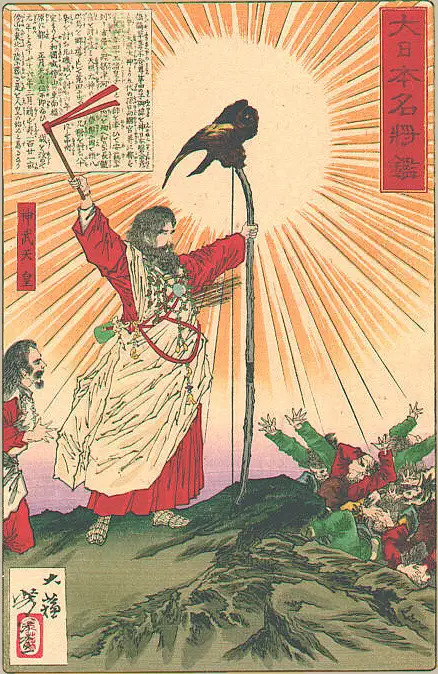
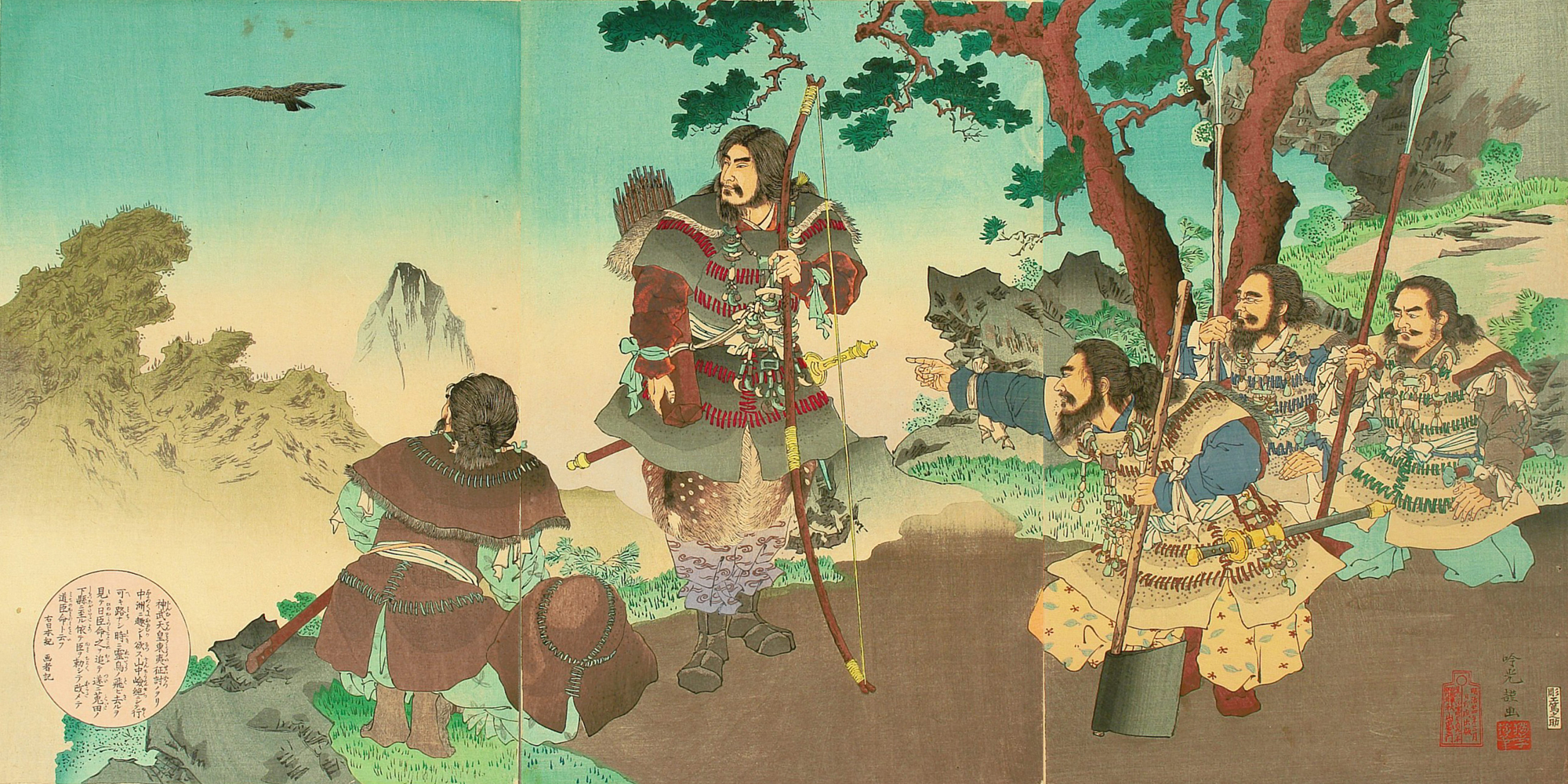 Jimmu, legendary first emperor of Japan and founder of the imperial dynasty. Jimmu, originally known as Iwarebiko, is said to have led his people eastward from Kyushu to the Yamato region (modern Nara Prefecture) to establish a central state. His expedition was fraught with challenges, including clashes with rival clans and the rugged terrain of Japan’s interior. One notable instance occurred during his eastward campaign when his forces encountered fierce resistance from local clans, particularly the Tomi Clan, led by the chieftain Nagasu. This formidable opponent had the advantage of knowledge of the terrain, and the early battles were so difficult that Jimmu and his army were forced to retreat to strategize. Another key challenge arose as they navigated the treacherous terrain of Japan’s interior. The rugged mountains and dense forests of the Kii Peninsula proved nearly impassable, slowing their progress and leaving the troops vulnerable to both natural hazards and enemy ambushes. In this moment of crisis, Jimmu received aid from the divine crow, Yatagarasu, which guided them through the labyrinthine wilderness to safer paths. One of the most significant challenges came in the form of a climatic battle against Eukashi, another powerful local chieftain, who fortified his position with strongholds and strategic advantages. Jimmu, receiving a vision from the gods, used superior strategy to outwit Eukashi, ultimately securing victory. His accession date, February 11, is celebrated as National Foundation Day in Japan. Although modern historians do not accept such details as a 7th century bc date, preferring a date in the Early Christian era, they affirm the tradition of an aggressive movement of peoples from the west. Jimmu Tennō (the posthumous reign name by which he is generally known) is said to have been a descendant of the sun goddess Amaterasu through her celestial grandson Ninigi, whom she sent down to govern earth, and he married a descendant of the storm god Susanoo. Despite Jimmu’s importance as a link between the ruling family of Japan and the divine ancestors, he has never had much of a cult following in Japan which is interesting.
These however are the mythical origins of the clan. From these sources, the foundation of the Imperial house is said to have been done at around 660BCE, but historical records tell us it was much later in around 540AD. That is because the historical evidence for the first 25 emperors is scant, and they are considered mythical, but there is sufficient evidence of an unbroken agnatic line since the early 6th century. Historically, verifiable emperors of Japan start from 539 CE with Emperor Kinmei, the 29th tennō. While the main line of the dynasty does not have a name and is referred to as Kōshitsu (imperial house), there are agnatic cadet branches which split during the course of centuries who received their own family names in order to distinguish them from the main line. They were considered a part of the imperial family (Kōzoku), with members carrying the title “Imperial Highness”, until the laws changed in 1947. The most important branches were the Shinnōke of which the most senior branch Fushimi-no-miya is first in the order of succession. Out of the Fushimi branch the Ōke branches split, which are the Kuni , Kaya, Asaka , Higashikuni and Takeda families as of 2024. Furthermore there are branches created from sons of the emperor who were excluded from the line of succession and demoted into the ranks of the court (kuge) or sword (buke) nobility. Such families are the Minamoto, Taira and Abe, as well as through in-laws the Tachibana for example. Out of these families further branches split through male descent who were also considered noble Japanese clans. The line of legitimate direct male descendants of emperors is therefore numerous.
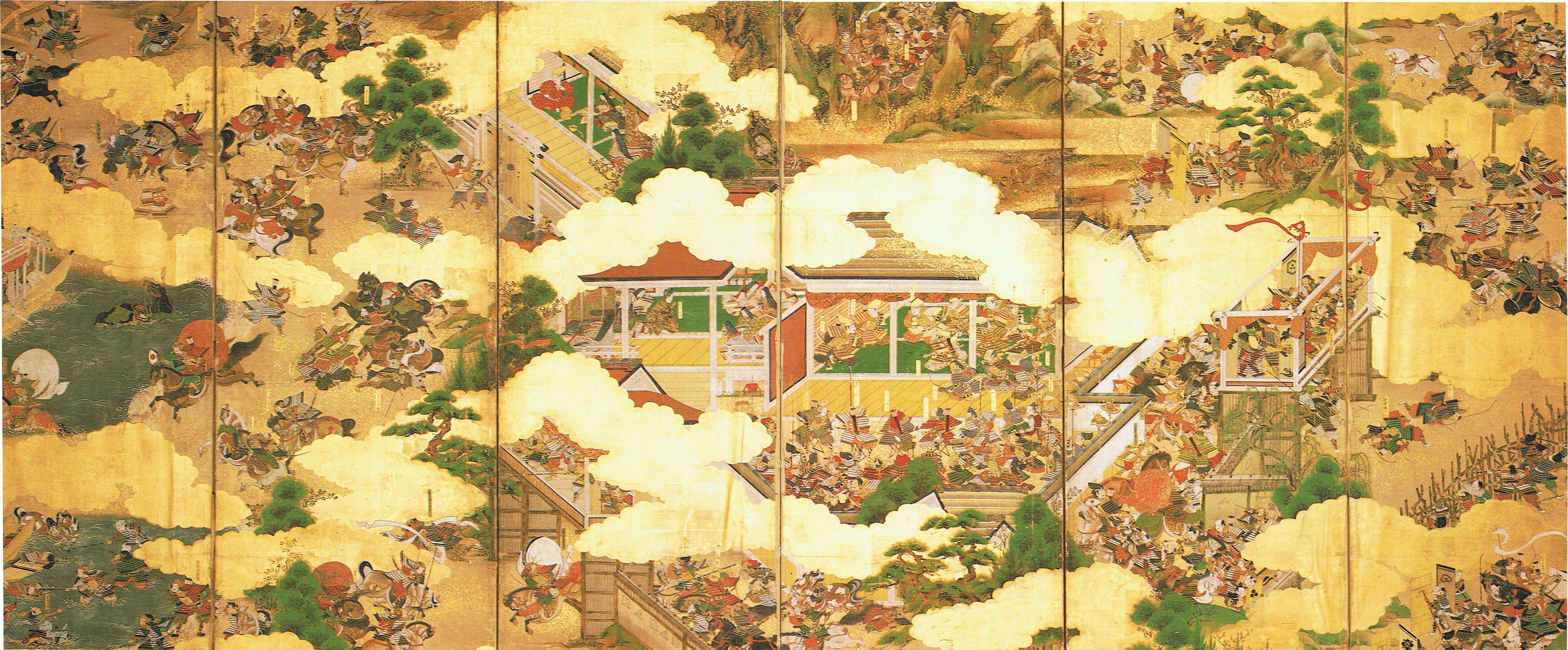
It is fascinating that the oldest reigning family has been ruling for more than 2 thousand years and claim divine lineage. To stay in power for so long shows how perfectly the first emperors created the traditions and culture specially in terms of loyalty and code of conduct. There has been instances of rebellion and revolts and some of them were successful, the Genpei war for example, the Taira and Minamoto clans culminated in the rise of the samurai class and the establishment of the Kamakura Shogunate where the Shogun was the real authority. Even then, the Emperor remained but was of no political power. We can assume from this instance that the people believed in their divine lineage and feared divine retribution for removing the emperor whom the gods had given the right to rule, from power. According to Shinto mythology, the emperor’s role was to mediate between the gods and the people, ensuring the prosperity and harmony of the land. To challenge the emperor was to disrupt this divine order, risking the wrath of the gods upon individuals, their families, or even their entire clans. During the Genpei War, leaders of both the Taira and Minamoto clans were careful to assert their loyalty to the emperor, framing their conflicts as struggles against each other rather than direct defiance of imperial authority. Belief in divine retribution played a critical role in maintaining loyalty to the emperor however pragmatic political and military considerations often outweighed spiritual fears when the stakes were high enough. Still, even successful rebels often took great care to preserve the emperor’s symbolic status to legitimize their own rule.
After World War II, the emperor’s divine status was renounced under the US imposed postwar constitution, and the monarchy became purely symbolic.